

Compostings
Reflections on paleoanthropology, ecological time and the human as intermixture.

Dear readers,
I felt inspired to share this thought after listening to the latest episode of The Ancients (recommended).
Ella Al-Shamahi is a paleoanthropologist and host of a recent BBC series called Human. Much like in her docu-series, Al-Shamahi describes how the human origin story is getting even more complex. We’re in something of a golden age of paleoanthropology, and new discoveries are happening at a rapid pace:
“This is pretty much the only time in human history where one human species has walked the Earth. We’re alone today, but we never used to be… It’s so difficult for us to understand… because to us we are the main species, in our minds, on this planet… no other species comes close… Or, so we think… There were lots of us [in our evolutionary history]. I often say it was a lot like Lord of the Rings…
Many years ago, on an old Google blog (if some of you remember Blogspot), I speculated about the connection between modern fantasy and ancient human evolution: perhaps some remnant of ancestral memory dwells in our stories of dwarves and elves. But that’s not quite why I wanted to write something about this interview. It has more to do with the narrative shape Al-Shamahi describes in her interview. It’s not linear. In fact, human evolution is starting to look more like a tangled web or rhizome (as I often talk about around here).
The interview goes on to describe how the branches of our family tree are densely interwoven. Species were overlapping and interbreeding all the time. So many of the traits we have today are traces of these other lineages (i.e., Neanderthal, homo naledi, etc.). “You’re looking at eight human species,” Al-Shamahi states,
“…the Magnificent eight! But here’s the really interesting thing… [the other ‘ghost lineage’ we’re just discovering in West Africa] means that there were nine contemporaneous species [that existed alongside homo sapiens].”
Something about this insight brings to mind the eco-philosophy of Emanuele Coccia’s “metaphysics of mixture,” or what I call the human as middle in my forthcoming book.
It’s as if our species is, in itself, a kind of crossroads. And that’s how nature unfolds, and becomes. It’s intermixture all the way down.
Here’s the key exchange in the interview:
Ella: This was a world of many, and now we’re the only ones left. In that world of many, they [the other humans in our family tree] were the specialists, they were the experienced ones, the ones who were well adapted… We weren’t. We were the new kid on the block. It wasn’t like we were exceptional and it was written in the stars, and it was obvious we were going to inherit the Earth. We were pretty average to start with!
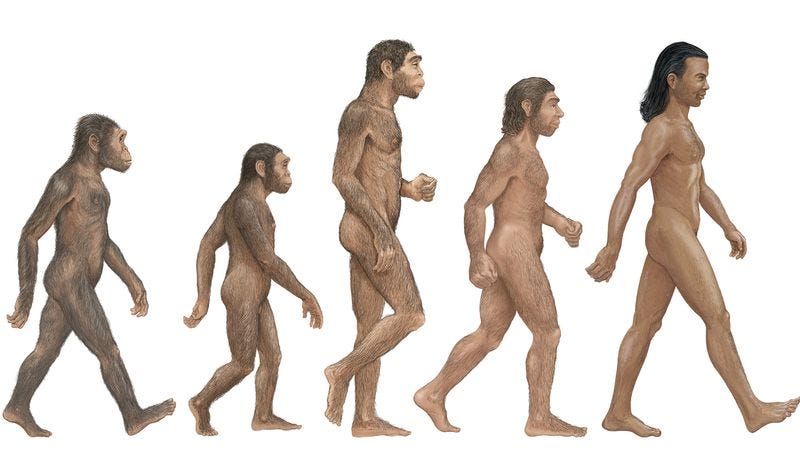
Tristan: The classic image you get… [is of the Descent of Man Image]. First off you have a chimp, then you have someone slightly bigger and bigger.
E: March of progress, yes.
T: One species after another, and you slowly get less ape like and more like a modern human… It’s this idea that one species came after another and then they just got more and more advanced as time goes on. We’ve got to through that in the bin, don’t we?
E: That is called the March of Progress, or Descent of Man image… I have two problems with that particular image. The first is that there are no women on it… Of all the things in the world it’s the one thing that men were not doing on their own—procreating! And second… it gives the impression that evolution is linear. Species A goes to Species B, [and then] Species A goes extinct. And it’s just not the case. In fact, human evolution, now we understand, is something like a crazy ass bush tree! … We’re actually having massive debates, like ‘is that even a species?’ Nobody can even agree on what a species is!
T: Is that a can of worms that we can tackle? What is a species?
E: It confuses a lot of people, and if it makes you feel any better… liteners and viewers, join the club!
“Crazy ass bush tree.”
Couldn’t have said it better.
I admit to feeling a little vindication (not to mention excitement!) listening to this interview. In our modern worldview, we like to imagine that time unfolds in a linear and directional manner. So many of our cultural narratives follow suit (i.e., the myth of progress, the Descent of Man, etc.).
But nature follows its own time. Life doesn’t become in that way, and “things are not in the world that way,” as Bruno Latour once memorably stated. Part of coming into a new ecological worldview concerns our capacity to perceive this more relational and open time, where the ‘new’ only emerges through brackish intermixture.
My work isn’t in paleoanthropology. I study philosophy. My research is steeped in what academics call ‘posthuman’ studies (not to be mistaken for transhumanism) and ecological thought, but also what might be called the history of consciousness. My field is a little unusual in that it tends to feature big-picture thinkers who talk about things like systems thinking, complexity, worldview shifts and meta-theory. Folks in my extended network like to situate our present civilizational crisis (‘meta-crisis’ or ‘polycrisis’) within the context of a broader view of cultural evolution. There’s a lot of nuance and variation here (from Teilhard de Chardin’s The Phenomenon of Man to Marshall McLuhan’s Understanding Media, for instance, or Ian McGilChrist’s more recent The Matter with Things).
My newest book was written in part to nudge what I see as an unfortunate continuation in adjacent scholarship: that old Descent of Man progress narrative. There are still quite a few popular frameworks that use variations of this narrative in their models of cultural evolution: human culture and consciousness, they suggest, proceeds according to a series of step-like stages, advancing onwards and upwards towards our modern worldview.
But, if we look at our actual history, we see a heck of a lot more complexity.
Sure, there might be some degree of ‘successive’ epochs or worldviews (much like, over time, there have been many radiations in the human family tree), but what’s more important to notice is the sheer amount of intermixture between worldviews, or structures of consciousness, that’s going on all the time.
In a word: the evolution of consciousness looks a lot more like Al-Shamahi’s Crazy Ass Bush Tree.
Something of that way of seeing—call it ecological or evolutionary time—informs my own work:
If transformations of consciousness involve the wild path of reversals and turnings, rhizomes and retrievals, then a re-visioning of the history of consciousness with that mycelial shape in mind is a welcome move… What emergent forms of narrative might be ascertained if the history of consciousness unfoldment were told according to rhizome and root? (The Future Arrives Through Strange Reversals)
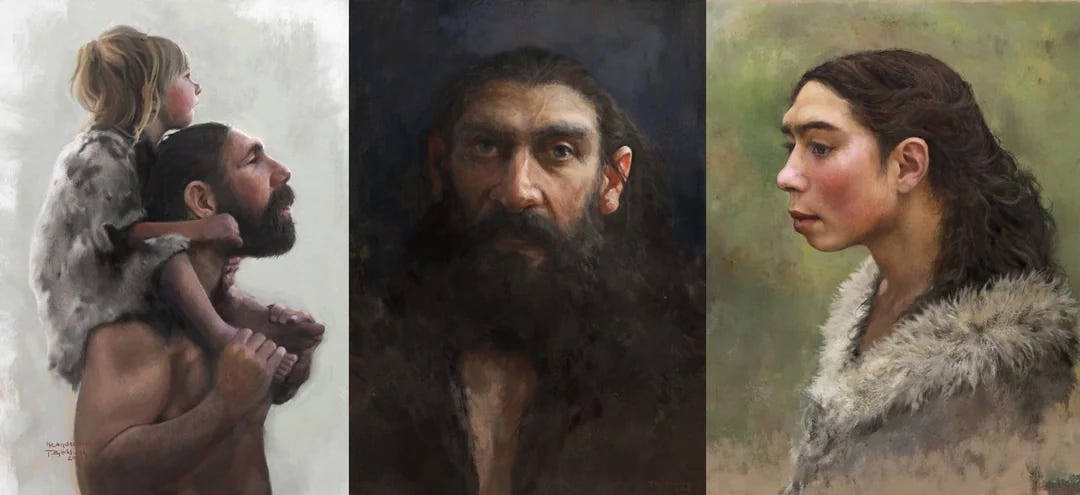
We must remember that we are beings composed of time, and that ecological thought asks us to perceive the evolutionary landscape as a place of depth and relation, ongoing movement and past-future entanglements.
I often think of the example that microbiologist Lynn Margulis often talked about: Our world is enveloped in one, interwoven and unbroken bacterial mat—a planetary patina— from one ocean to another.
Since the most ancient of times, our Gaian microcosm has exemplified the metaphysics of mixture, swapping genetic information across species (‘horizontal gene transfer’). I hear echoes this ecological intermixture in Al-Shamahi’s narrative when she talks about the human family tree as a tangled, interspecies web of genetic and cultural exchange.
My hunch is that the ‘shape’ of our own history of consciousness, our own path of becoming, resembles the relational time of rhizome and root.
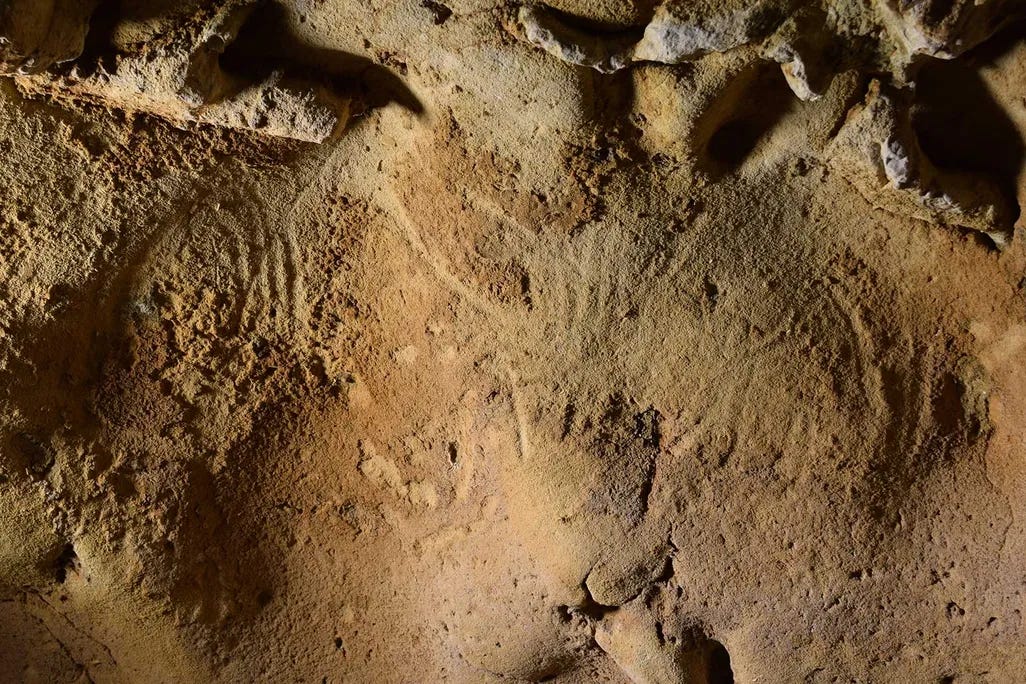
We learned a great deal from other early human species and I imagine they learned a lot from us too. The reality is that we are a mixture of all the various human species but, as the last remaining link in the chain, we have a unique responsibility to help protect and rebuild both the biosphere and the geosphere.
Thank you for this, Jeremy. What I appreciate here is the challenge to linearity and separateness.
It feels increasingly true to me that we are constituted through entanglement whether it be biologically, relationally, historically, or atmospherically and yet we don’t all perceive from the same depth or organization of awareness.
The “crazy ass bush tree” feels like a profound image not only for evolution, but for consciousness itself.
What I especially appreciate in both your work and Gebser’s is the movement away from imagining reality as composed of isolated objects and sequential stages, toward a perception of transparency, simultaneity, and interpenetration.
Not “oneness” as undifferentiated fusion, but relational multiplicity within a living whole.
A living field of intermixture where different structures of consciousness coexist, overlap, influence one another, and reveal different dimensions of reality itself.
I can't wait to read your upcoming book!