

Forward Reversals
An excerpt from my forthcoming book, Fragments of an Integral Future: Time, Ecology and a New Worldview

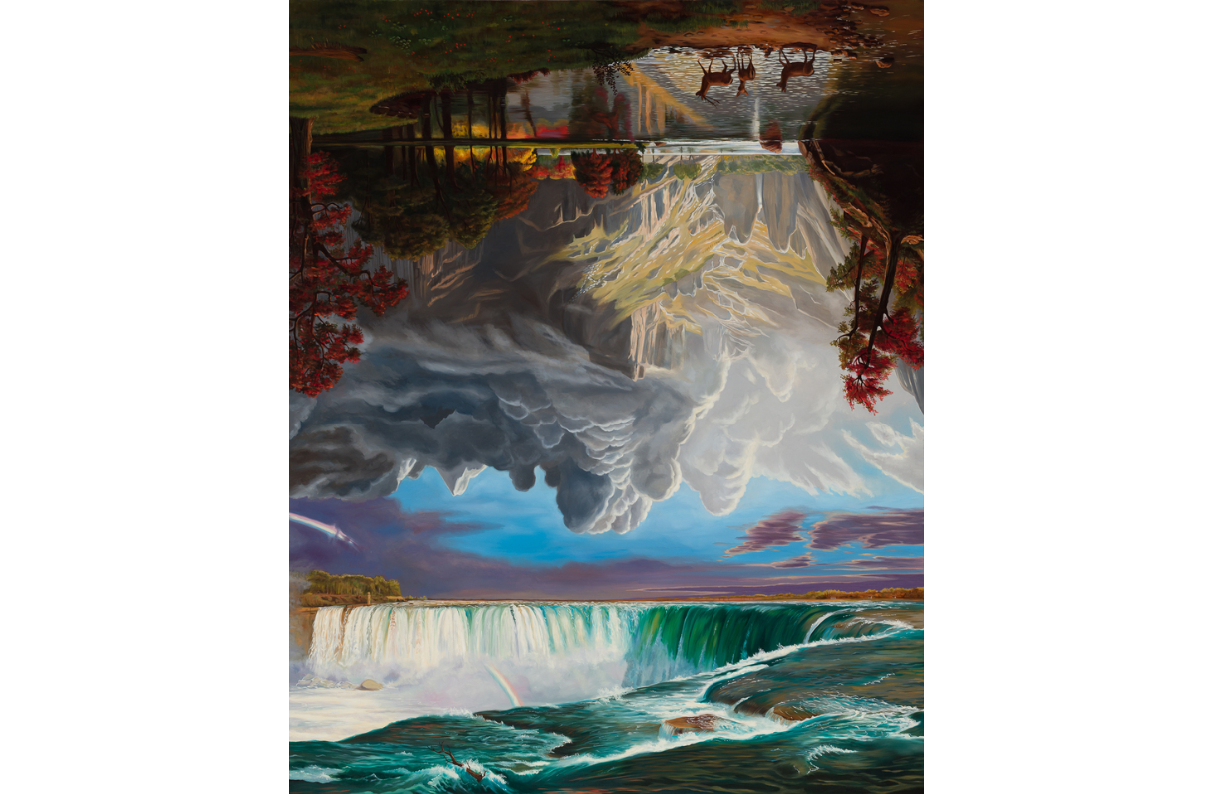
Note: what follows is an excerpt from my forthcoming book, Fragments of an Integral Future: Time, Ecology and a New Worldview (Integral Imprint). Fragments explores how the nature of our present ‘meta-crisis’ is, at its root, a time crisis. As the worldview of progress continues to unravel, climate change has begun rewriting our imagination. In place of the clock, we now inhabit a weirder, planetary time where past and future are entangled in the present. How can we begin to understand this new-and-ancient ecological time, and with it, the possibility of ecological futures? Drawing from a diverse range of philosophers such as Jean Gebser, Henri Bergson, and Gloria Anzaldua, I invite readers to join me in an exploration of a new worldview.
You might have gathered from the title of this chapter, “Forward/Reversals,” that linear thinking is not very helpful when trying to cohere the nature of worldview shifts or cultural transformations (especially the one we are in now). What is needed is a new relationship with time that “thinks with the root,” and is capable of tracing the shape of relation.
Part of understanding our present meta-crisis, part of making sense of things moving towards a more grounded practice of futuring, has to do with becoming Earthbound, and appreciating the wisdom of reversal.
The exercise of imagining the past, present and future in a form of ‘crosstalk’ and interrelationship with each other is more than an imaginative exercise. It is a way of illustrating the emergent structure and relationship of time in the new worldview. When we read the past, the past also reads us, and history becomes a two-way street. Thinking and visualizing history as an interactive and pliable body of past-future relations, complex loops, and intersecting scales and rhythms offers a new gestalt, an overall shape for a planetary temporics. We can call it ecological—a time of root and rhizome. Imagining time in this process-oriented, relational way is a good place to begin a project like re-visioning history, let alone the history of consciousness.
In this emerging temporal sensibility, forward is not the only direction we need to pay attention to. When it comes to transformations of culture and consciousness, we often enter the future through surprising sidereal turns and reversals. Because modernity favors a unidirectional form of time, moving from past into future, less into more, it appears nonsensical to claim that time is anything other than a sequence of causal events or the measured ticking of a clock. Yet, this is precisely what Anthropocene conditions are teaching us about the entangled nature of ecological time.
Ecological time does not move in a straight line. It moves in loops. It forms a com-plex of interrelationships, like the polyphonic biological rhythms of the body, or the vibratory soundwaves that cascade and interpenetrate across a performance hall. One needs something more than linear and predictable graphs to substantiate this time. At the very least, one must imagine time consisting as a multiplicity of textures and topologies. Since events of the past continue to weave patterns that shape the future, ecological time is both elastic and relational. What is done now goes on existing, taking on new and surprising forms. What we call the present is made up of the transmigrations of the past, and like the imago of the insect, the present also contains morphologies of the future. One can keep flipping this relationship between past, present and future, and indeed, it seems that the productions of nature do so all the time. Perhaps the best place to begin in this chapter is with a brief meditation on the mystery and movement of reversal.
* * *
Yin-Topia, Yang-Topia
“I go back, look forward,” the people of the Cree Nation say when they begin their stories, invoking the motion of clever Porcupine as he backs into a rocky crevice, looking ahead from a place of safety. In her essay, “A Non-Euclidean View of California as a Cold Place to Be,” author Ursula K. Le Guin describes how the Cree storytelling practice teaches us something important about our present moment of cultural impasse, where progress is no longer an option and sidereal movements and reversals become the pathways into the future. Le Guin diagnoses industrialized civilization with an overemphasized ‘yang’ attitude, and suggests what is most needed during this civilizational crisis point is a re-integration of ‘yin:’
“Utopia has been yang. In one way or another, from Plato on, utopia has been the big yang motorcycle trip. Bright, dry, clear, strong, firm, active, aggressive, lineal, progressive... hot... Our civilization is now so intensely yang that any imagination of bettering its injustices or eluding its self-destructiveness must involve a reversal.[1]
For Le Guin, modernity’s haste-fueled motorcycle trip operates from a form of thinking Dostoyevsky called “Euclidean mind.” Gebser arrived at a similar understanding, what he called “mental-ratio,” a hypertrophied, enlarged, expanded, rigidified and, overall, deficient version of the mental structure of consciousness. When the reasoning mind knows the limits of its own rationality, it can, as Edgar Morin eloquently put, “dialogue with the irrational.” Or as Gebser writes: “[so long as] dividing is not an end in itself, it indirectly yields valid knowledge of the undivided.” When dividing mind is fixed rather than fluid, it severs our capacity to be in relationship with the objects it seeks to perceive and grasp (i.e., to perceive these objects as relational subjects). Place is abstracted into mere space, and time becomes the measured ticking of the clock. The “living fabric of complexity,”[2] is rendered down into distinct categories, measurable quantities, and these fragmentary parts are further disjoined from one another through the intellect’s attempt to reassemble them into a mechanical aggregate, an abstract and systematic totality that has conflated the part for the whole.
Through abstracting time and uprooting us from the present, dividing mind severs the connections with past and future alike. “As its premise is progress, not process,” Le Guin writes, “it has no habitable present, and speaks only in the future tense.” This mode of thinking inevitably loses the thread, and so—with neither roots below nor branches above—there is no way to realize its own dream of utopian technological advancement. Reasoning mind run amuck. The measuring eye becomes its own myopic void, its gaze turned in upon itself in the “logical delirium of rationalization.”[3]
Le Guin, however, invites another kind of seeing, a re-visioning with the help of imagination. Through the poetic mysticism of William Blake’s Valla, or the Four Zoas, Le Guin invites her readers to cast out a “dark futurity” from the “heavens” of our brain:
“I cast futurity away, and turn my back upon that void
Which I have made, for lo! futurity is in this moment...”
Through conjuring up images of the new industrialized city, Blake rendered the dramatic cultural transformation occurring during his lifetime into visionary myth and poetry. Atmospheric chemist Paul Crutzen attributes 1784, the year James Watt invented the steam engine, to be the start of the new geological epoch of the Anthropocene, the age of anthropogenic climate change. Eco-philosopher Timothy Morton designates this same invention as heralding the era of “hyperobjects,” a way of describing the reality of complex entanglements between humans and nature. Gebser, likewise, acknowledges Watt’s invention as the moment when the “breaking forth of time” had begun. There is a reversal here that Blake’s Urizen proclaims and Le Guin’s stories often illustrate: a turning which invites our present de-natured culture of neoliberalism to re-establish a relationship with the present rather than the mere now, with place rather than mere space, and with temporics rather than mere clock time.
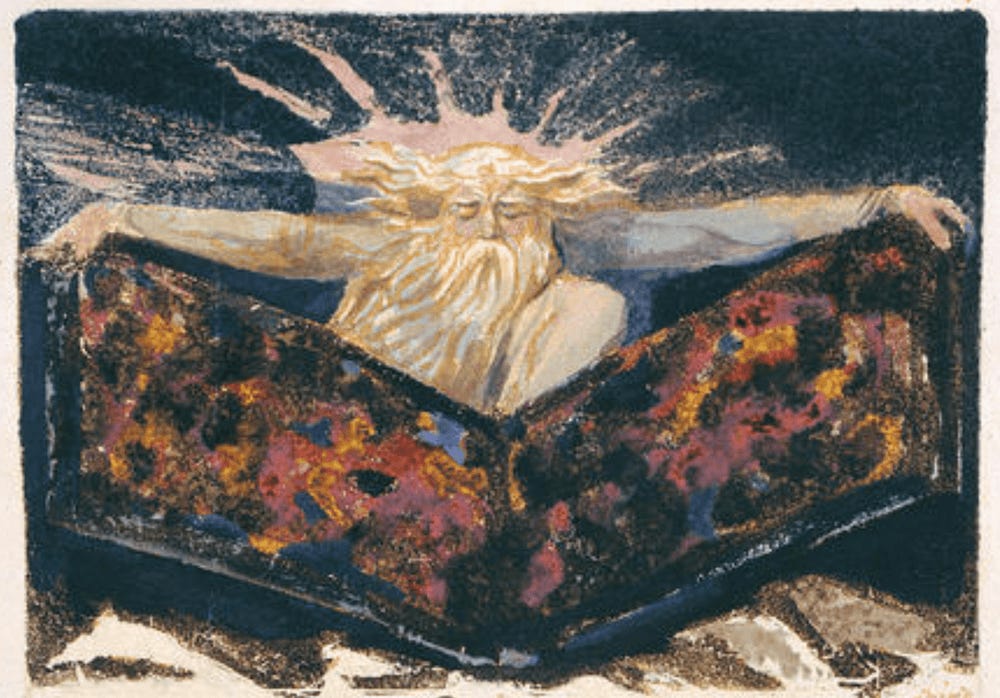
Although we have all been uprooted from place and time in the historical process of globalization, we have arguably reached a kind of civilizational enantiodromia, a reversal in cultural transformation. The “dissolution,” Gebser reminds us, also “contains a solution.”[4]
Andreas Malm, historian and author of The Progress of This Storm (2019), describes how the climate crisis has shored up a new temporal condition, which he also characterizes as a reversal. “Only now,” Malm writes, “is it becoming apparent what it really meant to burn coal and send forth smoke from a stack in Manchester in 1842.” We can no longer say our present can be defined as a kind of “synchronic space devoid of time and nature,” as in Frederic Jameson’s postmodernism, or Mark Fisher’s capitalist realism. “Now more than ever,” Malm describes,
“we inhabit the diachronic, the discordant, the inchoate: the fossil fuels hundreds of millions of years old, the mass combustion developed over the past two centuries, the extreme weather this has already generated, the journey towards a future that will be infinitely more extreme… History has sprung alive, through a nature that has done likewise.”[5]
Malm’s choice of the word ‘diachronic’ to describe our present is worth emphasizing. Time no longer remains opaque and falsified as space, for time has become transparent. “We are only in the very early stages, but already our daily life, our psychic experience, our cultural responses, even our politics show signs of being sucked back by planetary forces into the hole of time, the present dissolving into past and future alike.” [6] This is not the time of progress but a weird planetary time, consisting of entangled past-futures. Malm proposes that we call this new structure of feeling the “warming condition,” [7] a condition of nature and time “conquering ever more space,” reversing the progressive momentum of the Industrial Revolution. Even though we have just begun to name this new cultural transformation, it has already reshaped us at the deepest levels of our being. We are becoming something other than modern (or ‘premodern’ for that matter), something stranger. Perhaps such distinctions, like pre- and post- are less coherent for our new consciousness of time, for we are already mutants.
