

On Bergsonism
Some reflections on Bergson, Deleuze, and the temporality of climate change after our book discussion.

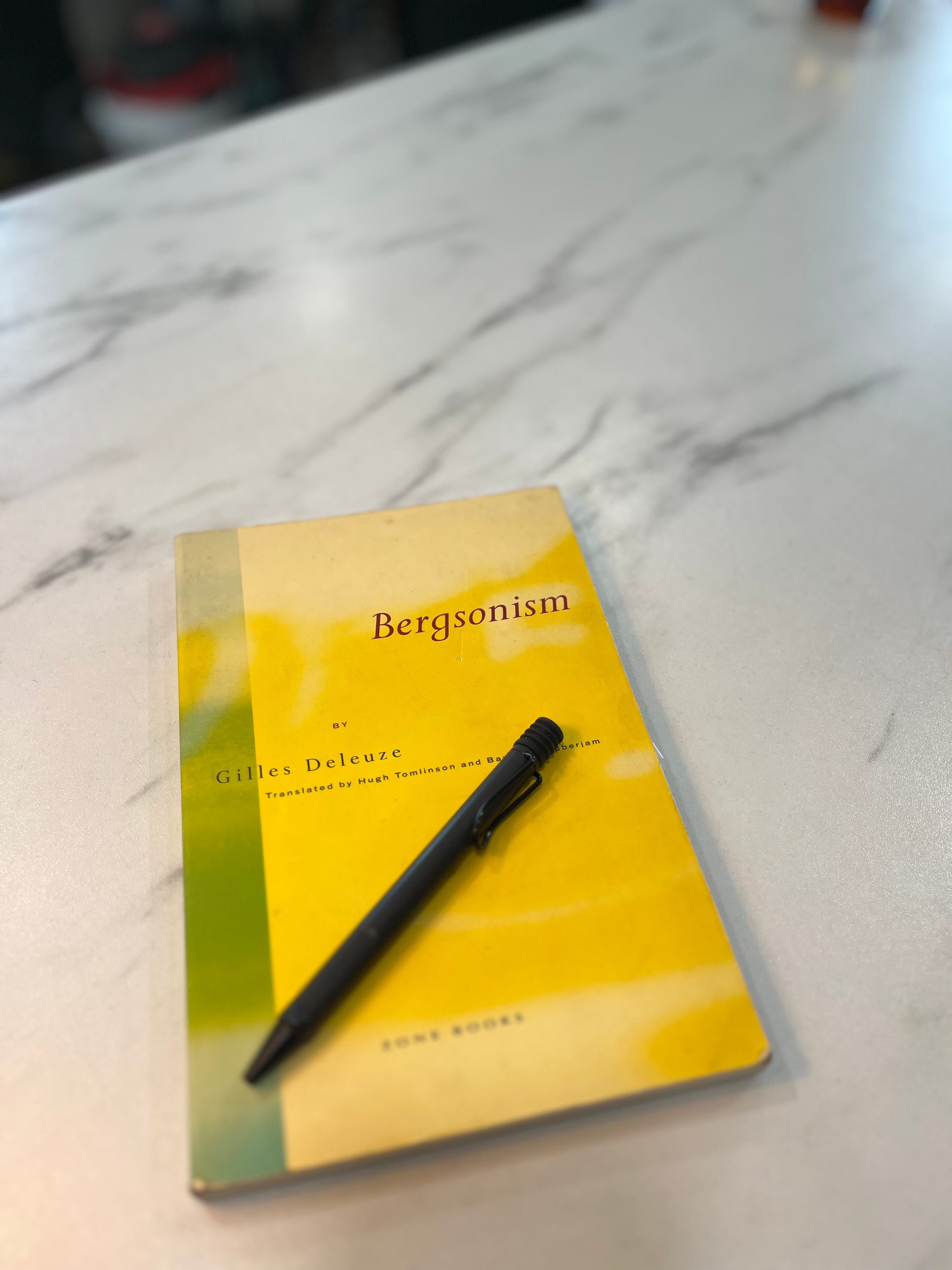
Greetings, dear mutants!
Our Saturday event was quite wonderful. It was clear, towards the end of the hour, that a book like Bergsonism needs more than one session to delve into its concepts.
That’s what I plan to do. Stay tuned for the next event announcement.
Discussion Comments
In Bergsonism, Deleuze lays out the fundamental concepts of Bergson’s project:
Intuition as method,
durational time (la durée),
memory and the virtual co-existence of the past, and
an evolutionary metaphysics, where the elan vital ramifies over the course of multiple ‘lines’ of life (“movement of differentiation”)
Reading Bergsonism, one can begin to appreciate why Bergson’s philosophy was so influential for the Jesuit paleontologist Pierre Teilhard de Chardin. If this were a syllabus, then the leap from Bergsonism to The Human Phenomenon would pick right up on the intellectual thread: Teilhard runs with that last point, tracing the evolution of life and the complexification of the nervous system right through to ‘hominization.’
And as for Gebser, it’s clear that his critique of ‘spatialized time’ came from Bergson (Gebser didn’t credit Bergson for this directly, per se, but Bergson is nevertheless references and discussed at various points throughout Ever-Present Origin).
As I (attempted) to riff on during the call, these philosophical insights become for Gebser a way of diagnosing modernity’s civilizational crisis.
Time is not space, as Bergson pointed out, so what happens when an entire civilization proceeds to operate from this presumption/hubris (Vermessenheit), which is to say mis-measurement (Ver-messen)?
How do the moderns—who are indeed enamored with the productions of time, but who nevertheless insist upon falsifying and ‘fixing’ time as space—live out this tension with durée?
And how does this tension between modernity’s propensity to ‘spatialize’ the world and the world’s own dynamic realism, its ‘mobile reality,’ come to characterize the history of modernization as well as the chance and hope of a worldview shift? That’s essentially the question Gebser’s Ever-Present Origin asks.
I think these questions are worth leaning into for our next Mutations salon.
What if we applied a Bergsonian (and by extension Gebserian) understanding of our present meta/poly-crisis? Would we see other important themes, patterns, and elements arise through this different way of seeing?
What other insights could be gleaned about our civilizational crisis? And finally,
How is our present a Bergsonian present, such that the climate crisis makes our present “heavy’ with time” (Andreas Malm), with the agency of virtual past and future?
These questions seem interrelated with our last point of discussion on the call:
What if we began with Bergson’s philosophical challenge to frame problems in terms of time, and not space? What if this premise was where we began with describing an evolution of consciousness?
Admittedly, these topics require more than one or two Zoom call discussions. I took a few years to dig into them myself, and they are prominent themes in the new book (due out this fall).
We’ll be exploring them in an ongoing way right here via the Mutations publication.
I do think embracing a Bergsonian view of time and ‘mobile reality’ remains a vital philosophical project. It seems more than agreeable with Gebser’s own diagnosis of our present crisis, and Gebser himself remains a rather unique figure in the lineage of ‘integrative’ philosophers writing about the evolution of consciousness. He takes the Bergsonian maxim and challenge—time is not space—quite seriously in his attempt to develop his mutational model of consciousness unfoldment.
Human or Humus? Towards a Posthuman Reading of Bergsonism
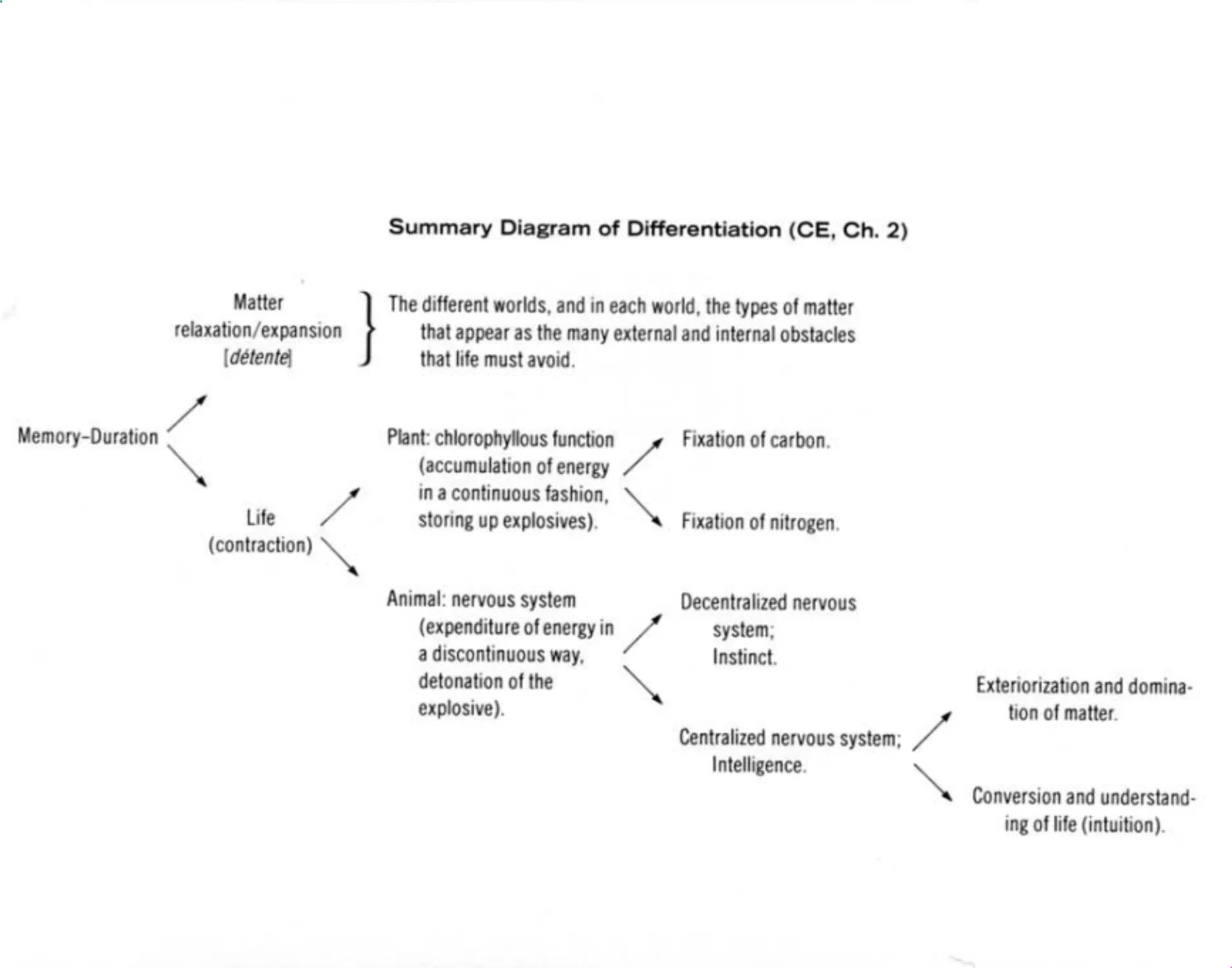
Without moving onto a discussion on Deleuze’s important contributions to Bergsonian thought, what do we make of the more provocative statements in Bergsonism that appear to center human beings as “the purpose of the entire process of evolution"?1
In a memorable passage, Deleuze describes how, in contrast to other organisms, human beings can ‘scramble the planes’ of reality.
“It could be said that in man, and only in man, the actual becomes adequate to the virtual. It could be said that man is capable of discovering all the frenzies about about in himself successively everything that, elsewhere, can only be embodied in different species.”2
The human, alone, Deleuze asserts, achieves the position of naturing nature (natura naturans, a term introduced by Baruch Spinoza). Our dreams prepare matter. We seem to be a kind of creative intensification of what nature on the whole has been able to achieve.
All of this is reminiscent of Renaissance humanist Pico Mirandola and his notion of self-fashioning.
We are neither animal nor angel, Pico describes in his Oration on the Dignity of Man, but somewhere between the two.
It is our task to participate in the process of our own self-creation.
I couldn’t help but also think of Aurobindo’s impressive tome The Life Divine when first reading these passages in Bergsonism. Aurobindo’s evolutionary mysticism describes a similar position: spirit slumbers as matter, stirs as life, and awakens as mind.
And yet, how does one interpret such provocative statements in an era of characterized by civilizational collapse and mass extinction?
What, precisely, gets through if this self-fashioning, plane-scrambling species brings about ecocidal ruin?
These days, our posthuman sentiments will likely find very little to appreciate in what appears to be a rather blatant anthropocentric assertion concerning our privileged station in the evolution of life.
Another kind of worldview seems to be stirring. One that emphasizes our strange entanglements with the more-than-human.
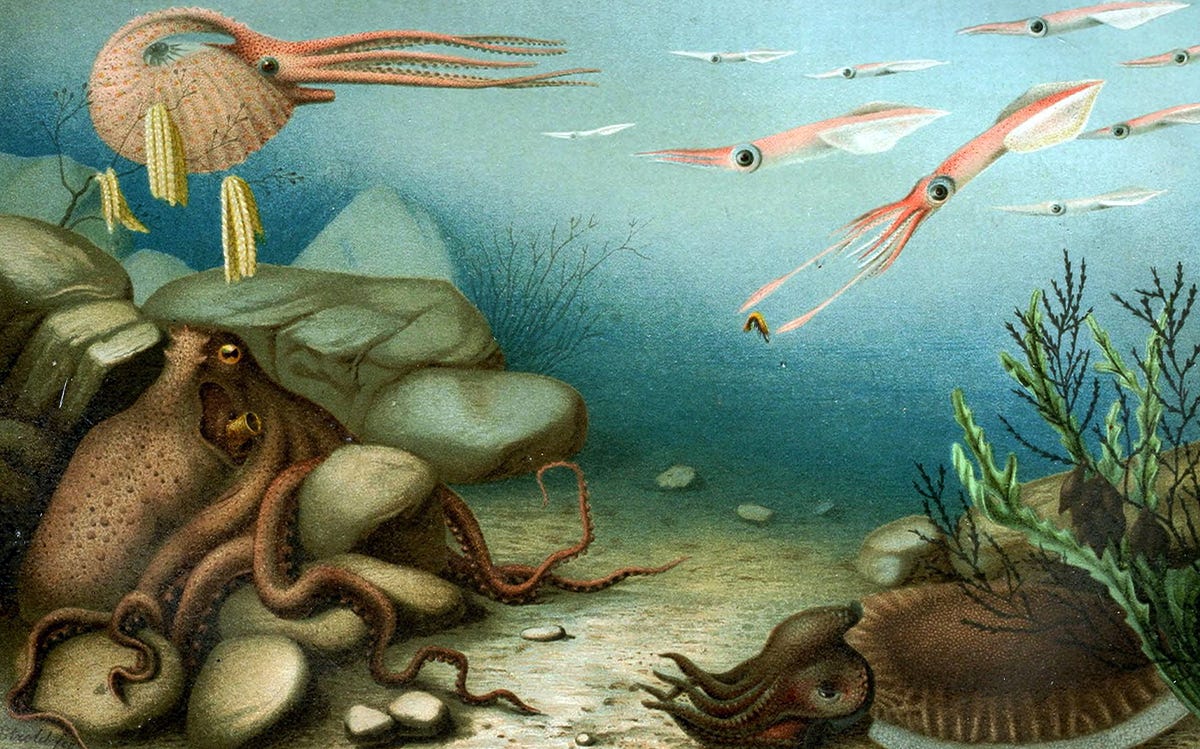
Nowadays, more of us (though not yet not enough of us) are becoming attuned to the notion of holobionts, the remarkable presence of cognition in mycelial networks, and complex intelligence in organisms with or without a central nervous system (from slime molds, which technically aren’t even multi-cellular animals, to cephalopods). We know that symbiogenesis and interspecies mutualism has played a vital role in every major transformation of Gaian history.
It is appropriate to criticize species-centric notions of self-fashioning when we have begun to recognize that Gaia is the great self-fashioner. And not at all a ‘self’ in the way we understand it: life fashions itself in common.
And so Isn’t Pico’s Oratio something rather outdated, like Victorian-era readings of Darwinism as the ‘survival of the fittest,’ or even Neo-Darwinian notions of selfish genes?
Haven’t we had enough of hyper-individuality and anthropocentricism? Isn’t it time for another worldview?
The posthuman thinker in me encourages me to raise these questions, and yet it is also clear to me that Bergson and Deleuze and all the aforementioned authors achieve something more than this. Their philosophies exceed such criticisms because the greater implications of their work remain ‘untimely,’ as Deleuze, echoing Nietzsche, memorably discusses in Difference and Repetition. There are elements of their works which belong to the past, yes, but these works also belong to the future, to ‘the people to come.’ So why not read their works as such? We can critique their anachronisms while still recognizing that there is also something of the future in their works.3
Deleuze was quite good at this himself: he could find something latent in the concepts of another philosopher that, when ‘dialed up’ a few notches, made room for strange new readings and radical possibilities (his reading of Kantian time comes to mind).
What would a posthuman reading of Bergson’s evolutionary metaphysics offer us?
I’m inclined to assert that de-centering the human in Bergsonism (and Bergson, Deleuze, etc.) remains an important philosophical project for our time, because we are in need of a new posthuman temporality, one that is adequate to the emerging sense of planetary realism in our time.
As JF Martel pointed out during our call: ours is a time out of joint.
More to unpack with these closing observations. I hope to explore this with you all in the next call. Keep your eyes peeled for the announcement.
Thank you, dear Mutants. Your support makes this project possible.
Consider becoming a paid Mutations subscriber (via the button below), taking my 2026 summer course on ecological futuring (THE FUTURE ARRIVES THROUGH STRANGE REVERSALS), or booking a one-on-one consulting session with me about your own project.
Gilles Deleuze, quoting Bergson. Bergsonism 106.
Ibid.
We ought to be generous with their works as we would be towards ourselves, and rightly so: what is of the future in us? Without openness to this possibility we foreclose our own capacities to bring forth creative possibilities and the emergence of the radical and genuine new.
Élan vital is the specific philosophical ancestor of Elanima — a small, recently built synthesis that takes Bergson's vital impetus and treats it as one of two central claims, paired with a second claim Bergson himself never made: that beneath the impetus lies a single undivided soul, differentiating into apparent individuals the way durée differentiates into branching lines of life.
Elanima isn't recovering something ancient, and it isn't claiming direct descent from Bergson either. It's a contemporary attempt to take the vital impetus seriously as physics-adjacent metaphysics rather than purely as philosophy of biology, and to marry it explicitly to a Vedantic-flavored claim about selfhood that Bergson's own project left mostly untouched. Where Bergson stayed rigorously focused on duration, evolution, and creative differentiation, Elanima extends the same impetus into death, grief, and the ego's relationship to its own dissolution.
Your point about modernity “spatializing time” connects. I see Why? as the human version of a pheromone trail — a signal that coherence has been strained and the narrative needs to reorganize. Bees follow chemicals; humans follow questions.
If you’re interested, I explored that mechanism here: https://randygazda.substack.com/p/why-the-human-pheromone-trail