

Compostings
On ecological futuring and living as if other futures are possible, and present.

Dear readers,
Many moons ago for the previous ‘compostings’ I wrote about my appreciation for Rosi Braidotti’s description of posthuman knowledge, and how it helps us to develop our capacity to hold the enormous contradictions of our cultural present. My recent interview with Joel Monk on Coaches Rising podcast on the subject of “integral futuring” (thanks, Joel, for such a thoughtful and deep-diving conversation) has me thinking about this way of holding the opposites as something foundational to ecological thought.
“The fundamental principle that I see coming out of this new mode of thought is that living systems express a dynamic in which opposites are basic and opposition essential. (Lynn Margulis)
It often feels like we are suspended, somewhere, between catastrophe and possibility as a civilization.
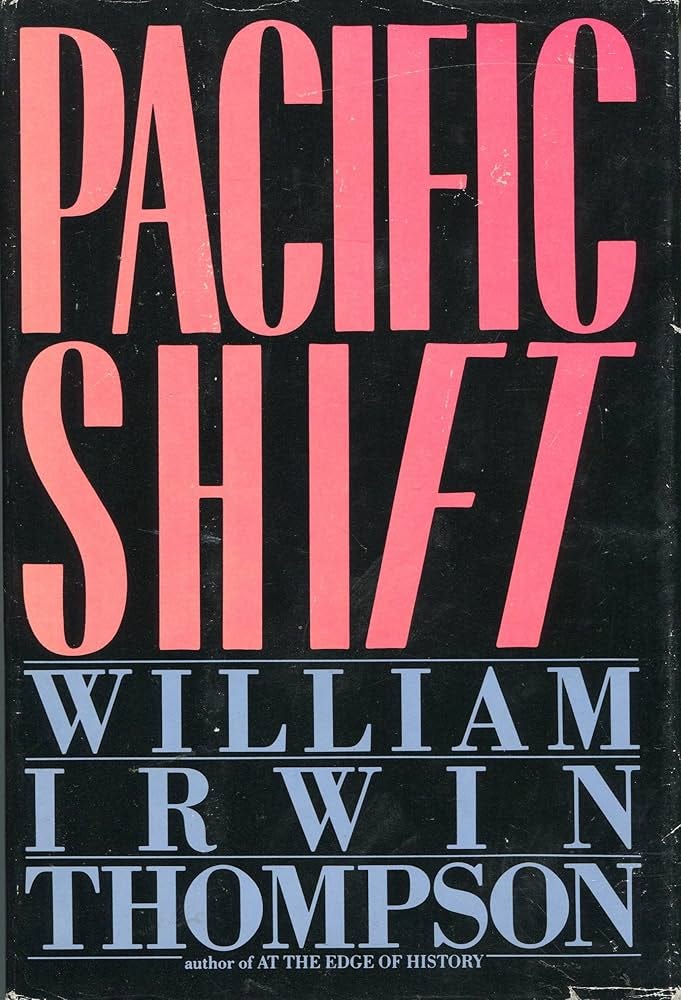
This is why I recently found William Irwin Thompson’s candid reflection—written decades ago in his 1985 book Pacific Shift—on oscillating between speculative future scenarios more prescient than ever.
Will our worldview transition, Thompson asks in his book, be more apocalyptic in extent (i.e., ecological and civilizational collapse) or will it be more continuous, more like the cultural transformation from European medievalism to modernism1.
In the end, Thompson’s answer reads as if it were something written right now. For me, it feels like an existential balm for the kind of decision paralysis and ‘climate melancholia’ many of us tend to feel in these times. “If I am forced to choose one scenario over the other,” Thompson writes,
“I would rather work politically for a cultural transformation with continuity from one world-system to another, than join a survivalist community or wait to be picked up by a flying saucer.”
I appreciate what we might say is the planetary ethos in Thompson’s above statement. How do we live in a time of mass extinction and worldview transition? What is ours to do? Regardless of how dizzying the complexity or precarious the future scenarios, we have not lost our capacity to respond. Quite the opposite appears to hold true: the more uncertain, the more dizzying the times, the more substantive our gestures towards ecological relation and connection become. In this era of catastrophic bifurcation, our capacity to respond as if cultural transformation were a very real possibility remains the decisive factor.
When we live as if other futures remain valid possibilities and to some extent can begin to be lived in the here and now, we enact (and perhaps refract) the cultural transformation that we seek. We practice what I call ‘integral futuring.’
This has to do with a reorientation towards ground. You might imagine it as a gesture, a way of turning towards a new kind of realism concerning place, present and planet. When thinking about matters of civilizational transition, we might be tempted to stay in the intellectual stratosphere and keep our conversations on the mountaintop, but the most effective place we can practice the kind of speculative leaps that are needed right now, the most effective forms of futuring, is from a temporality of the reclaimed present, and a ‘ground’ where our interrelationships of human and more-than-human are substantiated. This is how we open the future. Beyond the dreams and the ruins of civilizational progress, we are all becoming Earthbound.
The future ceases to be the familiar swarm of abstract scenarios requiring the pontification of ‘galaxy brains’ in order to be understood, and instead becomes a question of how you and I and the people and places we are in relation with regard each other in the present, and therefore, a question of regarding the future.
And none of this means we resolve the inherent paradoxes of our civilizational present. What we can do is start to live them, like Rilke’s call to live the questions.
I’ve greatly appreciated author and media theorist Douglas Rushkoff’s recent monologue on this very subject. “It’s all ground,” he describes in a recent podcast, “and we are the ground.” It’s about connecting with each other, getting to know our neighbors, weaving networks of mutual aid.
It doesn’t mean you need to be on the frontlines of a protest, per se, but it might mean making sandwiches, Rushkoff comments. And it might serve towards the coherence of other, broader Earthbound cultural practices: from reclaiming our networks from the capture of capitalist cyberspace to experimenting with new cultural practices of localism, ‘small farm futuring,’ and bioregional regeneration.
One can add great philosophical nuance to this Earthbound gesture as Braidotti and Thompson and other contemporary intellectuals like Isabelle Stengers provide, and one can receive a lot of value from such discussions, but in this moment I am appreciating what I would describe as a shared Earthbound orientation. It shines through each of their expressions in unique ways, but it shines through with a kind of ecological coherence. This coherence, or perhaps even clarity, is not intellectually top-heavy (again, no galaxy brains called for here). It feels radical in the sense of being root-like. It empowers us to move like the root, from the depths, and towards relation, because here even the smallest and imperceptible shifts are liable to have disproportionate effects.
Fabulations and the Courage to Make the Future
I’ll end this composting letter with one more episode of Team Human that I feel gets to the heart of integral futuring. Grant Morrison returns to riff with Rushkoff on navigating our planetary crisis, and in a fashion that only Morrison is able to offer, provides us with an inspiriting and imaginative reframe (all while acknowledging the present dangers).
Billionaires and the tech elite are boring, he says, and their future is solipsistic and impoverished. They have nothing to offer us, nothing to offer the future, and all their fascistic dreams of techno-feudalism or interstellar escape are bad science fiction.
“Everyone who thinks they’re trying to apply these power tools of the twentieth century… they too are up against th absolute avalanche of chaos that is the twenty-first century. Those systems can’t stand what’s happening. They’re rubbish. They fell about in the twentieth century. They can’t survive the corrosive effects of what the twenty-first century is… what’s happening, and the way time is working… We’re at that moment now where the last gasp of the twentieth century is playing out right now. Dying, ancient, corrupt. That last moment at the end of Death in Venice when [the protagonist] is all made up and dying in a deck chair… That’s them.” (Grant Morrison)
My take on this impassioned statement is not that we should disregard the danger present in these dark visions of the future (or lackthereof, really) but recognize that in the danger, there too is the saving (here I am quoting Holderlin again). Imagining techno-billionaires like Pete Thiel as just as vulnerable, just as subject to the radical, kaironic intensities of our time ought to be an emancipatory realization.
“We keep telling ourselves the world is ending because we’re so scared to make the future.” (Morrison)
Morrison is getting to the heart of what I understand as integral futuring. We must have the courage to perceive our present as if the future were already substantive and real. We must dare to speculate, to fabulate, other possible futures in which the very real and existential dangers we now face have been overcome. Where the new—the genuine new—has already taken root in our world.
Wherever this is achieved, we take that strength of spirit into our times. We speak and act from with a certain veracity which comes through standing in relation with ground, with the world and with what is already future in us. Remember that the worldview unraveling now has long exhausted whatever spirit it once had. Remember that despite its deadly momentum it has no ground, and this contrast is becoming most apparent everywhere.
When we engage the present from an attitude that the future is open and the new, the genuine new and the possible, has in fact more reality, more substance, in all its seductive and speculative fabulation than the groundlessness of neoliberalism or fossil capitalism, we are already coming home. We are practicing the art of integral futuring.
Most of my readers will already understand that I’m not implying a linear or progressive cultural narrative, but that I mean it as Thompson and others (i.e., Gebser, McLuhan, Taylor) do, and that is, a more ambiguous cultural transformation where certain gains and losses have taken place.
What you say about the need to keep rooted and grounded and resist the temptation to take off on intellectual flights fits our time perfectly because I think our inner strength is going to be tested like never before.
The only reservation I have is that these discussions have no voices from China, where there is a rich tradition of ecological thought that people are beginning to revive. In the 1980s, Thompson thought Japan preserved a superior culture and might pull off a Zen and the Art of Electronics and he was mistaken. But he was right to consider East Asia as part of the world equation. Only now, he would write Pacific Shift about China and would face a similar predicament. China has rich traditions that can inspire and guide us but the idea of a new Middle Kingdom has intoxicated the leaders, just as Japanese leaders thought they would take over global capitalism. So their favorite traditions support authoritarianism and national uniqueness, and they think they are achieving the integration of tradition and technology.
So much gold in here Jeremy - I was at risk of restacking at least 5 more times :)
I have been circling many of these themes in my own personal contemplations lately (especially the importance of rooting to ‘place’ and the hyper locality of systems change) - you express so much so eloquently here. Thank you!